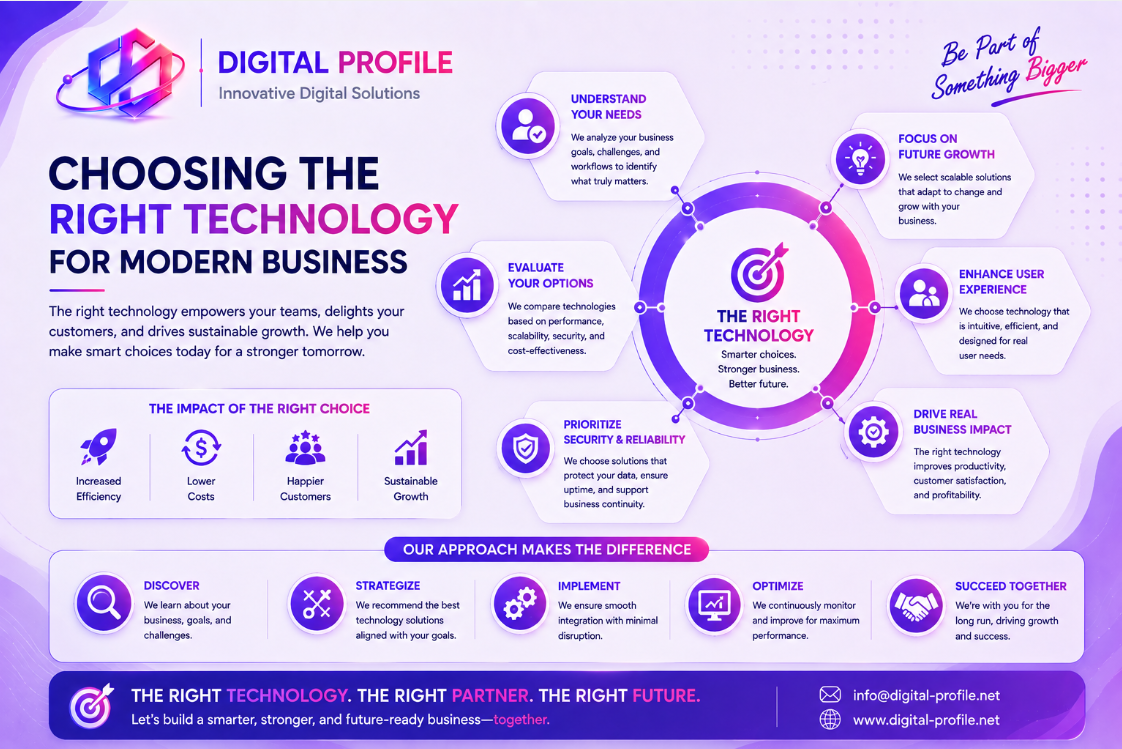
Choosing technology for a business is no longer simply about purchasing the newest software or adopting the latest digital trend. Businesses need technology that solves practical problems, supports employees, protects information, connects with existing systems, and remains useful as the organization grows.
The right technology decision starts with understanding the business itself. By evaluating requirements, workflows, costs, security, scalability, integration, and long-term value, businesses can make technology investments with greater confidence.
Start With the Business Problem
One of the most common technology mistakes is starting with a product instead of starting with a problem. Businesses may discover a new platform or software solution and immediately ask whether they should use it.
A better approach is to identify the operational problem first. Technology should have a clear purpose within the business.
- What process is currently inefficient?
- What tasks consume unnecessary employee time?
- Where are errors or delays occurring?
- What information is difficult to access?
- Which business processes are difficult to scale?
- What customer experience needs improvement?
Understand the Business Requirements
Once the problem is identified, the next step is to define what the technology actually needs to accomplish. Clear requirements make it easier to compare different solutions objectively.
Requirements may include functional needs, technical requirements, user needs, security expectations, reporting capabilities, integrations, and future expansion.
- Required features and functionality
- Number of users and teams
- Existing systems and applications
- Data storage and reporting requirements
- Security and access requirements
- Integration requirements
- Future business requirements
Consider Scalability
A technology solution that works for a small business today may not be suitable when the organization grows. Choosing technology should therefore involve more than evaluating current requirements.
Businesses should consider how the system will perform as the number of customers, employees, transactions, data, and connected applications increases.
Scalable technology does not necessarily mean choosing the most powerful or expensive solution. It means selecting an architecture and platform that can reasonably support expected growth without creating unnecessary complexity.
Evaluate Integration With Existing Systems
Businesses rarely operate using a single application. Websites, accounting systems, customer management platforms, communication tools, databases, payment services, and internal applications may all be part of the same operational environment.
A new technology solution should therefore be evaluated based on how well it can work with the systems already in place.
- API availability
- Database compatibility
- Third-party integrations
- Authentication and user management
- Data import and export
- Workflow compatibility
Do Not Overlook Security
Business technology often handles sensitive information, including customer records, employee information, financial data, credentials, documents, and operational information.
Security should therefore be considered before adopting a new system rather than treated as an afterthought.
- User authentication
- Role-based access controls
- Data protection
- Secure communication
- Backup and recovery capabilities
- Software maintenance and updates
- Security monitoring
Compare Total Cost Instead of Purchase Price
The cheapest technology option is not always the least expensive solution in the long term. Businesses should consider the complete cost of ownership before making a decision.
Depending on the solution, costs may include subscriptions, hosting, implementation, customization, integrations, maintenance, training, support, upgrades, and migration.
- Initial implementation cost
- Subscription or licensing fees
- Hosting and infrastructure
- Customization and development
- Integration costs
- Employee training
- Ongoing maintenance and support
Consider Usability and Employee Adoption
Even a technically advanced system can fail to deliver value if employees find it difficult to use.
Technology should make important business processes easier rather than creating unnecessary complexity. Employees should understand how the system supports their daily responsibilities and why the change is beneficial.
Before adopting a solution, businesses should consider its interface, learning curve, accessibility, training requirements, documentation, and support options.
Choose Between Existing Software and Custom Solutions
Businesses often need to decide whether to purchase an existing software platform or develop a solution tailored to their specific requirements.
Off-the-shelf software can provide faster implementation and established features. Custom software can provide greater control over workflows, integrations, user experiences, and business-specific requirements.
- Choose existing software when standard features meet the business requirements.
- Consider customization when the business has unique workflows.
- Consider custom development when existing platforms create significant operational limitations.
- Evaluate integration requirements before selecting either approach.
- Compare long-term costs and maintenance requirements.
Think About the Long-Term Technology Strategy
Technology decisions should support the broader direction of the business. A solution that solves a short-term problem but creates significant limitations later may become expensive to replace.
Businesses should consider how a technology decision fits into their future plans, including expansion, automation, cloud adoption, data management, security, customer experience, and operational efficiency.
- Future business growth
- Additional users and locations
- Increased data requirements
- Future automation opportunities
- New integrations
- Changing customer expectations
- Future security requirements
Choosing Technology With Confidence
Choosing business technology is ultimately a strategic decision. The right solution should address real business needs while providing a reasonable balance between functionality, usability, security, integration, scalability, and cost.
Businesses do not necessarily need the newest platform, the largest technology stack, or the most advanced features. They need technology that solves meaningful problems and supports the way their organization works.
A thoughtful technology strategy can help businesses reduce operational friction, improve productivity, strengthen customer experiences, and create a stronger foundation for future growth.
Need Help Choosing the Right Technology?
Explore practical digital solutions designed to help businesses select, build, integrate, and improve technology systems around their real operational needs.
Discuss Your Project