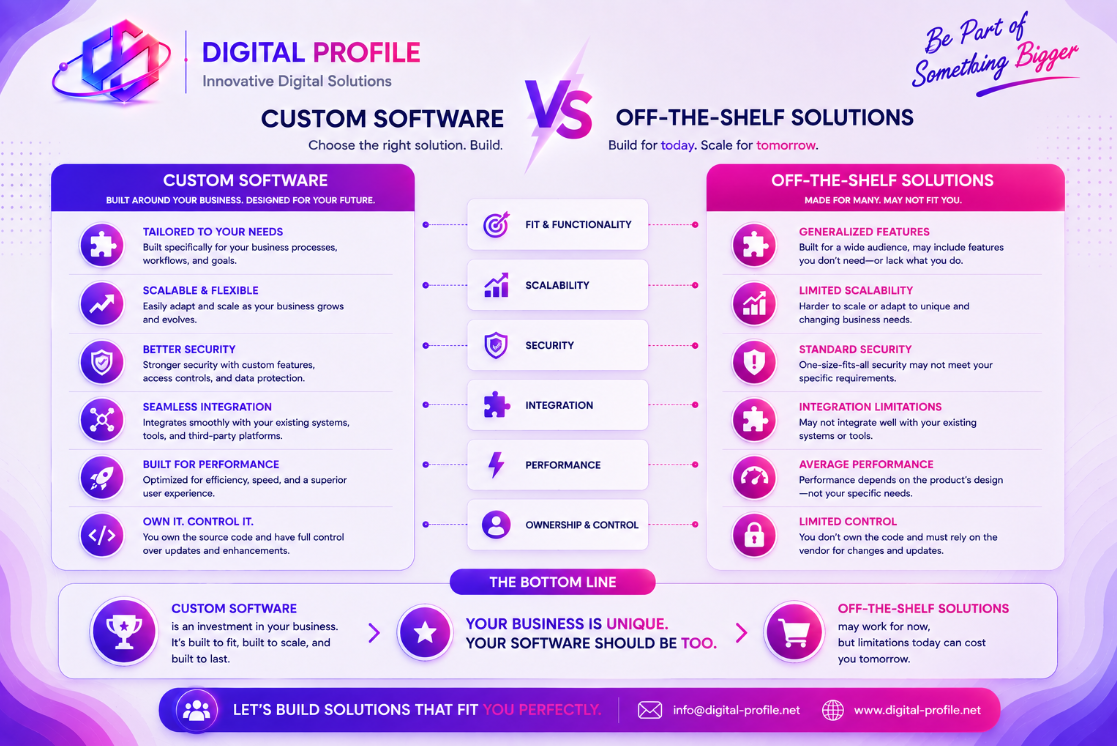
Choosing the right software can have a significant impact on how efficiently a business operates. Organizations often face an important decision: should they purchase an existing software product or invest in a custom solution built around their specific requirements?
Both approaches can be effective. The right choice depends on the organization's workflows, budget, technical requirements, scalability goals, and long-term strategy.
What Is Off-the-Shelf Software?
Off-the-shelf software is a ready-made application developed for a broad market. Instead of being designed specifically for one organization, it provides a predefined set of features intended to address common business requirements.
Examples can include accounting platforms, customer relationship management systems, project management applications, communication tools, and other business productivity software.
What Is Custom Software?
Custom software is designed and developed around the specific requirements of a business, organization, or project.
Instead of changing business processes to fit a predefined application, custom development allows the software to be designed around the organization's existing workflows, users, data, integrations, and operational requirements.
- Business-specific workflows
- Custom dashboards and reporting
- Integration with existing systems
- Role-based access and permissions
- Specialized business processes
- Custom automation
- Scalable architecture
Custom Software vs. Off-the-Shelf: The Key Differences
The biggest difference is flexibility. Off-the-shelf products generally provide a standardized experience, while custom software can be designed around the exact requirements of an organization.
The goal should not simply be to select the option with the most features. Businesses should evaluate how well the software fits their actual operational requirements.
Cost and Initial Investment
Off-the-shelf software often has a lower initial cost because development expenses are distributed across many customers. Depending on the product, businesses may pay through subscriptions, licenses, usage-based pricing, or other commercial models.
Custom software typically requires a larger initial investment because the system must be planned, designed, developed, tested, deployed, and maintained specifically for the organization.
Flexibility and Customization
Customization is one of the strongest advantages of custom software. Features, interfaces, workflows, permissions, reports, and integrations can be designed around the organization's needs.
Off-the-shelf platforms may offer configuration options, plugins, extensions, or APIs. However, businesses generally remain within the boundaries of what the vendor supports.
- Custom workflows
- Custom user interfaces
- Specialized reports
- Business-specific automation
- Custom integrations
Scalability and Business Growth
As a business grows, its software requirements can change. More users, additional locations, increased transaction volume, new integrations, and more complex workflows may require changes to the underlying system.
Custom software can be architected with future requirements in mind. This may make it easier to extend the system as the organization evolves.
Off-the-shelf software can also scale effectively, particularly when the vendor provides appropriate infrastructure and plans. However, businesses may eventually encounter feature or configuration limitations depending on the product.
Integration With Existing Systems
Modern businesses rarely operate using a single application. They may use accounting systems, customer management platforms, databases, cloud services, communication tools, payment systems, and internal applications.
Software integration allows these systems to exchange information and work together more efficiently.
Custom software can be designed specifically around required integrations, while off-the-shelf platforms typically depend on the APIs, connectors, and integration capabilities provided by the vendor.
Security and Control
Security should be considered regardless of which software approach a business chooses.
With custom software, organizations can define application architecture, authentication mechanisms, permissions, data handling, and security requirements according to the project's needs.
Established software vendors may also provide strong security capabilities, infrastructure, monitoring, updates, and security controls. However, businesses remain dependent on the vendor's security practices and product roadmap.
Maintenance and Long-Term Support
Off-the-shelf software is generally maintained by the vendor. Updates, improvements, infrastructure, and technical support may be included depending on the product and subscription plan.
Custom software requires an ongoing maintenance strategy. Businesses need to plan for security updates, bug fixes, infrastructure, improvements, backups, monitoring, and future development.
This additional responsibility can also provide greater control over how and when the software evolves.
When Off-the-Shelf Software Makes Sense
Ready-made software can be an excellent choice when the business has common requirements and needs a solution quickly.
- The required features are already available
- The business needs rapid deployment
- The budget favors a subscription or license model
- Extensive customization is not required
- The vendor provides suitable integrations
- The software can support expected business growth
When Custom Software Makes Sense
Custom software becomes more attractive when existing products cannot effectively support the way a business operates.
- The business has unique workflows
- Existing products require excessive workarounds
- Specialized integrations are required
- Business processes need significant automation
- The organization requires greater control
- The software needs to support a specialized business model
- Long-term scalability is a major consideration
A Practical Decision Framework
The best decision starts with the business problem, not the technology itself.
Before selecting a solution, businesses should document their workflows, identify operational challenges, determine required features, review integration requirements, and estimate both initial and long-term costs.
- What problem are we trying to solve?
- Are existing products able to solve it effectively?
- How much customization is required?
- What systems need to be integrated?
- How will the software need to scale?
- What level of control is required?
- What is the expected long-term cost?
Choosing the Right Software Strategy
Custom software and off-the-shelf software both have an important place in modern business technology. Neither option is automatically better for every organization.
Off-the-shelf software can provide a fast and practical solution for common business requirements. Custom software can provide greater flexibility and control when an organization's processes require a more specialized approach.
The most important consideration is how well the technology supports the business. Instead of choosing software based solely on price or feature count, organizations should evaluate the complete picture: workflow efficiency, integrations, scalability, security, maintenance, and long-term value.
When software is aligned with the way a business actually operates, technology becomes more than a tool. It becomes part of the organization's ability to operate efficiently, serve customers, and grow.
Need Software Built Around Your Business?
Explore custom digital solutions designed to support your workflows, integrate your systems, automate repetitive processes, and create a scalable foundation for business growth.
Discuss Your Project