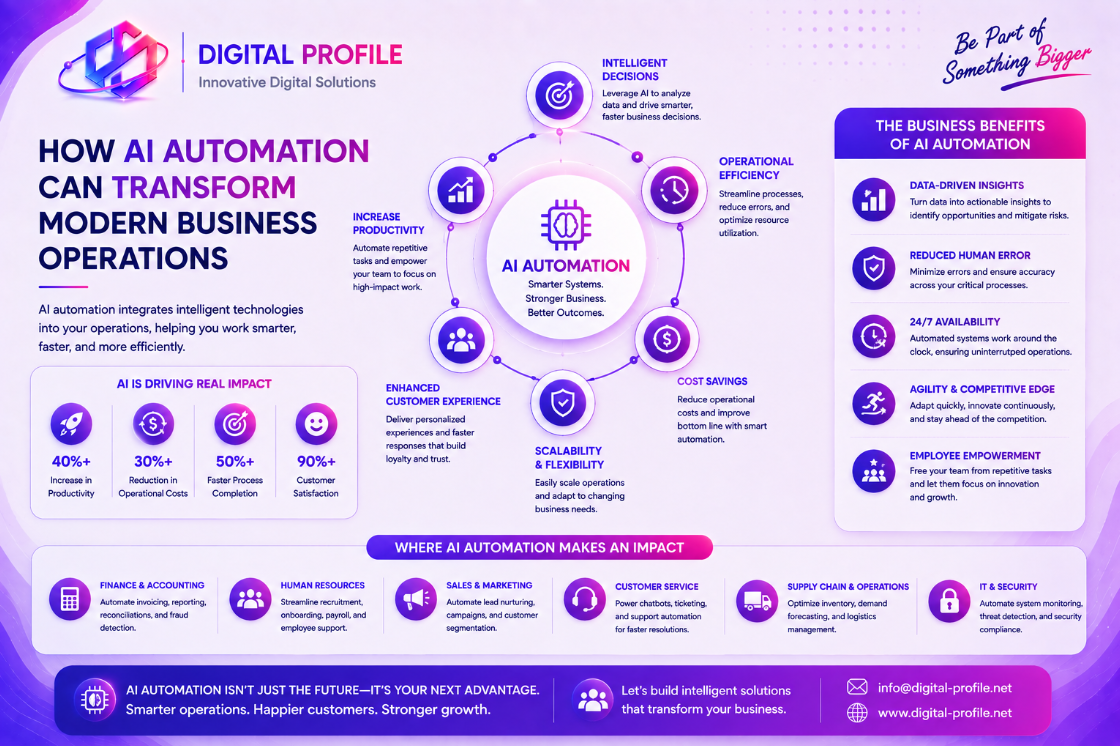
Artificial intelligence is changing the way modern businesses approach everyday operations. From customer support and document processing to data analysis and workflow management, AI automation can help organizations reduce repetitive work, improve consistency, and make better use of their resources.
What Is AI Automation?
AI automation combines artificial intelligence with automated workflows to perform tasks that traditionally require manual effort.
Traditional automation generally follows predefined rules. AI-powered automation can go further by analyzing information, recognizing patterns, understanding natural language, and assisting with decisions based on available data.
Why Businesses Are Turning to AI Automation
Many businesses spend significant amounts of time on repetitive administrative tasks. Employees may need to process emails, organize documents, update records, respond to common questions, prepare reports, or move information between different systems.
Although these tasks may appear small individually, they can consume substantial amounts of time when repeated every day.
- Reduce repetitive manual work
- Improve workflow efficiency
- Process information more quickly
- Reduce avoidable human errors
- Improve customer response times
- Organize business information more effectively
- Support employees with intelligent tools
Automating Repetitive Administrative Tasks
Administrative work is one of the most practical areas for AI automation. Businesses can use intelligent workflows to assist with repetitive processes that consume employee time.
- Email classification and routing
- Document organization
- Data entry and information extraction
- Appointment and request processing
- Automated report generation
- Internal notifications
- Customer inquiry routing
Instead of manually reviewing every incoming request, an automated system can analyze the information, identify its category, and route it to the appropriate workflow or team.
Improving Customer Support
Customer expectations are increasingly centered around speed and convenience. AI automation can help businesses provide faster responses by handling common questions and assisting support teams with relevant information.
More complex, sensitive, or unusual requests can still be escalated to a human representative. This creates a balanced approach where automation handles routine workloads while people remain responsible for decisions requiring judgment and context.
Streamlining Business Workflows
Modern businesses often rely on multiple applications to manage daily operations. Customer information may exist in one system, documents in another, communication in email, and operational records somewhere else.
AI automation can help connect these processes into more efficient workflows, reducing unnecessary manual movement of information between systems.
Making Better Use of Business Data
Businesses generate large amounts of information every day. The challenge is often not collecting data but turning that information into something useful.
AI-powered systems can assist with analyzing business information, identifying patterns, summarizing large amounts of content, and presenting relevant insights to decision-makers.
This can help businesses spend less time manually organizing information and more time using it to guide business decisions.
AI Automation Does Not Replace Human Expertise
One of the most important considerations when adopting AI automation is understanding where automation should and should not be used.
AI is particularly useful for repetitive, structured, and information-heavy processes. Human expertise remains essential for strategy, relationships, creativity, accountability, and decisions that require context.
How Businesses Can Start With AI Automation
Businesses do not need to automate everything at once. A practical approach is to begin with one clearly defined process and measure the results.
- Identify repetitive business processes
- Determine where employees spend unnecessary time
- Review the systems and data involved
- Select a suitable automation approach
- Test the workflow with a limited scope
- Measure efficiency and business impact
- Improve and expand the workflow gradually
The Future of AI-Powered Business Operations
AI automation is becoming an important part of modern digital business strategy. As AI technologies continue to improve, businesses will have more opportunities to automate repetitive processes, connect systems, improve customer experiences, and make better use of their data.
The most successful implementations will not simply focus on using AI because it is new. They will focus on solving real operational problems and creating measurable improvements.
For modern businesses, the opportunity is clear: identify where technology can remove unnecessary complexity and use automation to create a more efficient, scalable, and intelligent operation.
Ready to Improve Your Business Operations?
Explore practical digital solutions designed to help modern businesses streamline workflows, improve efficiency, and build smarter technology systems.
Discuss Your Project