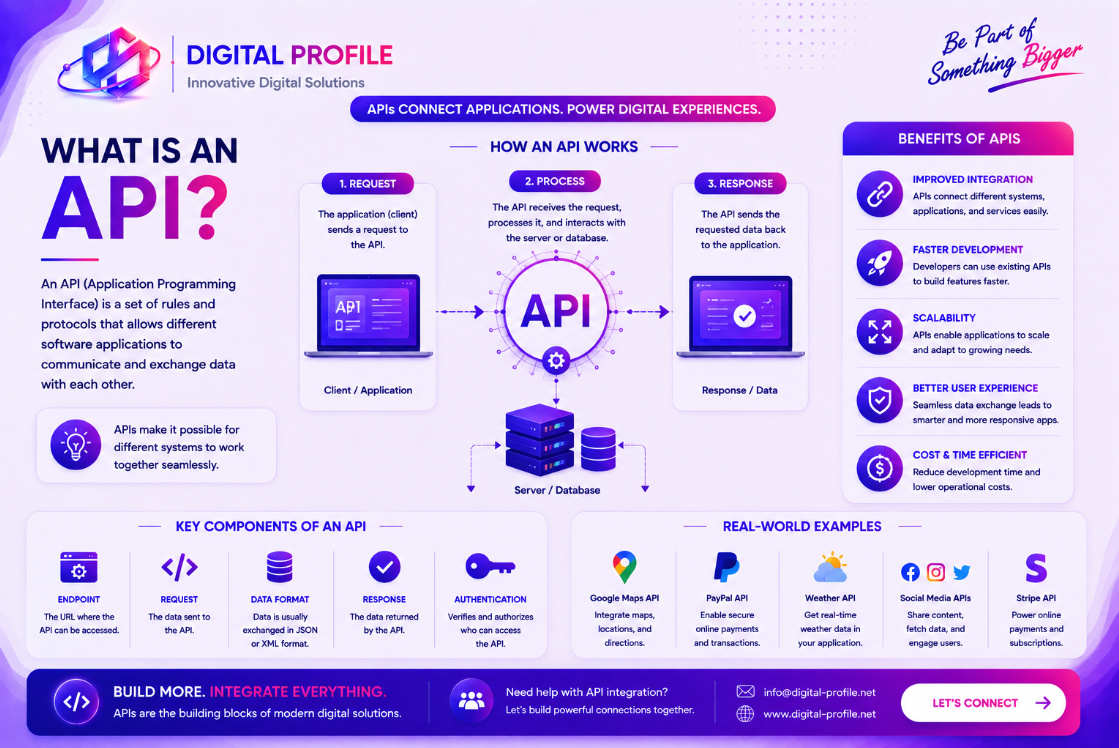
APIs are one of the most important building blocks of modern software. Whenever a website retrieves information from another system, an application communicates with a payment provider, or two business platforms exchange data, an API is often working behind the scenes.
Although the term "API" can sound technical, the basic concept is relatively simple: an API provides a structured way for one software system to communicate with another.
What Is an API?
API stands for Application Programming Interface. It is a set of rules and methods that allows different software applications or systems to communicate with each other.
Instead of requiring one application to understand the internal code or database structure of another application, the API provides a controlled interface for requesting information or performing specific actions.
A Simple Real-World Example
Imagine using a food delivery application. You select a restaurant and place an order. The application may need to communicate with several different systems to process that transaction.
The application could use APIs to communicate with the restaurant's ordering system, payment provider, mapping service, notification platform, and delivery system.
The application does not need direct access to every system's internal database. Instead, it communicates through defined interfaces.
How Does an API Work?
Most web APIs work through a request-and-response model. A client application sends a request to an API endpoint, and the server processes the request before returning a response.
A typical API interaction may include several components:
- The client application
- An API endpoint
- A request method
- Authentication or authorization
- Request data or parameters
- Server-side processing
- A response containing data or a result
For example, a website may request a list of products from an API. The server processes the request and returns the requested information, often in a structured format such as JSON.
What Is an API Endpoint?
An API endpoint is a specific URL or location through which an application can access a particular resource or operation.
A business API might provide different endpoints for customers, products, orders, payments, or user accounts.
- Customer information
- Product information
- Orders
- Payments
- Authentication
- Reports and analytics
Common API Request Methods
Many web APIs use HTTP methods to describe what the client wants to do with a resource.
- GET — retrieve information
- POST — create or submit information
- PUT — replace or update a resource
- PATCH — partially update a resource
- DELETE — remove a resource
These methods help establish a consistent way for applications to communicate with web services.
What Is a REST API?
REST, or Representational State Transfer, is a commonly used architectural approach for building web APIs.
REST APIs typically use standard HTTP methods and resources to allow applications to interact with data and services over the web.
REST APIs are popular because they are relatively simple, widely supported, and suitable for many types of web and business applications.
How Businesses Use APIs
APIs are especially valuable for businesses because modern organizations often rely on multiple applications and services.
APIs allow these systems to exchange information and automate processes without requiring every system to be rebuilt from scratch.
- Connecting websites with business systems
- Integrating payment providers
- Connecting CRM and customer platforms
- Synchronizing inventory
- Connecting accounting systems
- Integrating communication services
- Connecting mobile applications
- Building internal business tools
APIs and Third-Party Integrations
Many online services provide APIs so developers can integrate their functionality into other applications.
For example, a business website might integrate a payment service, mapping provider, email platform, analytics system, or customer management platform through an API.
This allows businesses to use specialized services without having to develop every capability internally.
API Security and Authentication
APIs often provide access to business data and system functionality, so security is an important part of API development.
Depending on the system, APIs may use authentication mechanisms such as API keys, tokens, OAuth, or other security approaches.
- Authenticate users and applications
- Control access to resources
- Protect sensitive information
- Validate incoming requests
- Apply rate limits where appropriate
- Monitor API activity
Why APIs Matter for Modern Software
Modern applications rarely operate in complete isolation. Businesses increasingly depend on interconnected systems, cloud services, mobile applications, automation tools, and external platforms.
APIs provide the communication layer that makes many of these integrations possible.
- Improve system integration
- Reduce duplicate development
- Enable automation
- Support mobile and web applications
- Connect cloud services
- Enable scalable digital platforms
- Support business process integration
APIs Are the Connection Layer of Modern Digital Systems
An API is essentially a structured way for software systems to communicate. It allows applications to request information, submit data, trigger actions, and connect with other services without needing direct access to their internal implementation.
From small websites to large enterprise platforms, APIs make it possible to build connected digital experiences and integrate different technologies into a single business workflow.
Understanding APIs is therefore an important step for anyone working with modern websites, applications, automation, cloud platforms, or business software.
Whether you need to connect an existing application, integrate a third-party service, or build a custom business system, a well-designed API can provide the foundation for reliable and scalable integration.
Need to Connect Your Business Systems?
Explore custom API development and integration solutions designed to connect websites, applications, business systems, databases, and third-party services.
Discuss Your Project